Homegrown
How one alum is cultivating Manhattan’s tech future
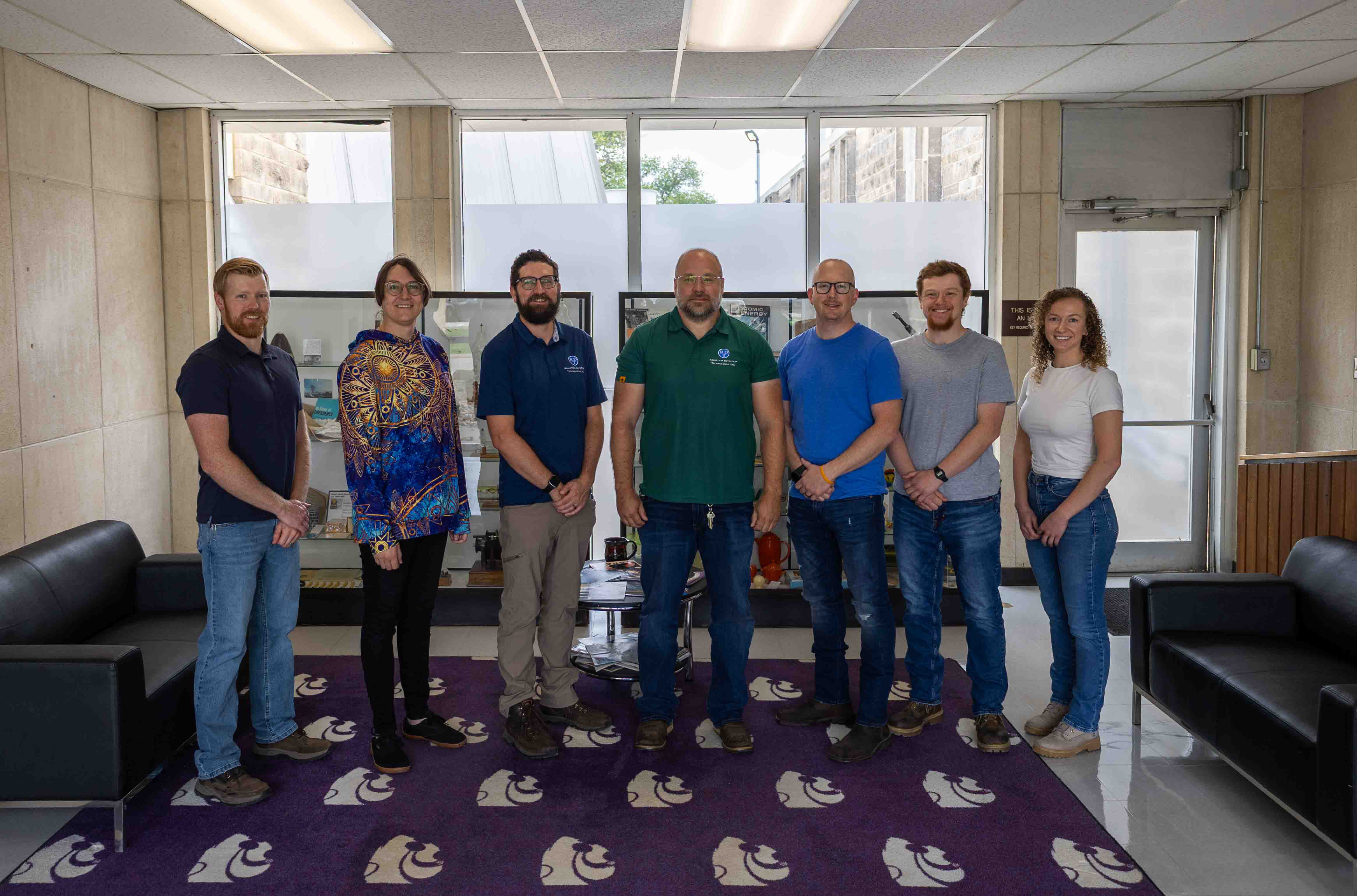
K-State alumnae who now work at RDT from left: Cody Rietcheck, Jennie Whitmore, Taylor Ochs, Steven Bellinger, Benjamin Montag, Jacob Clanton and Kylie Wilkerson.

By Julia Hall
Graduate School
Friday, July 24, 2026
Steve Bellinger doesn’t fit the typical mold of a nuclear technology CEO. On weekends you’ll find him on his family farm outside of Manhattan, doing the same work he’s always done – planting, harvesting, fixing machinery, and solving whatever problem the day throws at him. It’s the same work that shaped him long before he stepped foot in a laboratory.
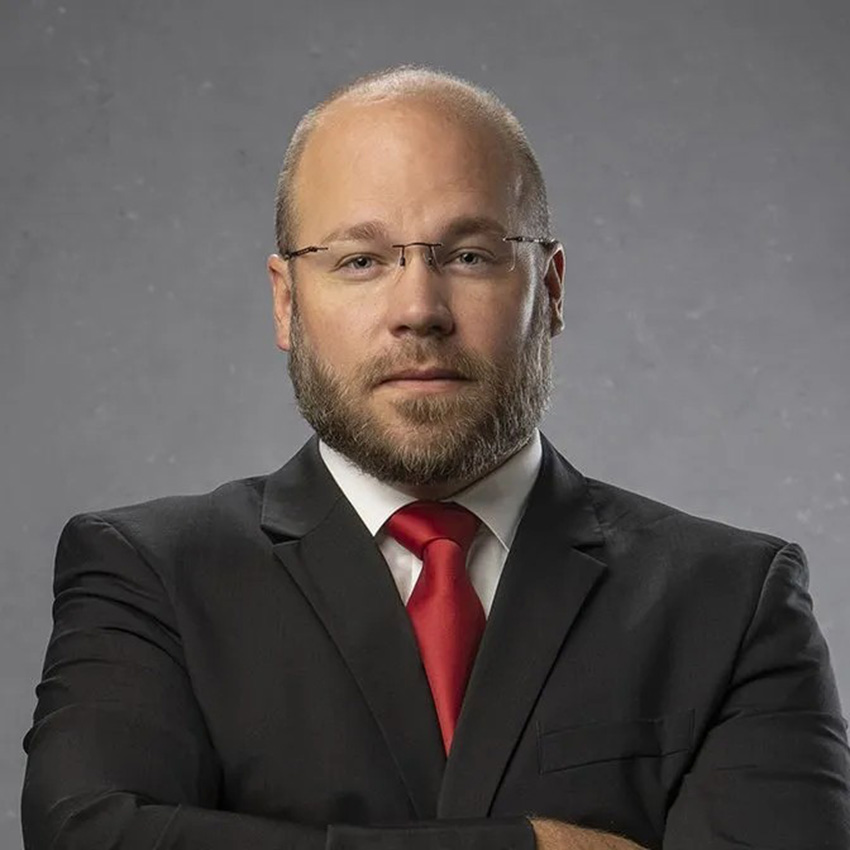
“Running a business is in my blood,” Bellinger says. “We were trained on the farm how to make every dollar count.”
Growing up, the path forward seemed simple enough: stay on the farm or go to K-State. Bellinger’s love of mathematics, physics, and STEM classes in high school was enough to show his parents a real passion for education. They both encouraged him to attend university. He chose K-State so he could still come home and help his brothers on the farm.
Bellinger arrived at Kansas State University in 2000 as a first-generation college student, enrolling in mechanical engineering with a nuclear option. Mechanical engineering allowed him to take all the base sciences and apply them, while the nuclear option let him go to the atomic level, of how things were made.
It was in the Semiconductor Materials and Radiological Technologies (SMART) Lab where everything clicked. As an undergraduate researcher, Bellinger moved out of the lecture hall and into the work itself. Building and fabricating devices for radiation sensing, learning by doing. His instincts from the farm translated more directly than anyone might have expected. Fixing vacuum pumps in a high-end research lab, it turns out, isn’t all that different from fixing a piece of equipment on the farm.
The technology that would define his career was already taking shape around him. The early stages of a device called the Microstructured Semiconductor Neutron Detector (MSND) had been brought to K-State by Dr. Douglas McGregor from the University of Michigan. Bellinger was working on the prototypes in the SMART lab.
After completing his undergraduate degree, Bellinger continued directly into a PhD program in nuclear engineering. Graduate school, Bellinger will tell you, changes what you are after. “When I started, I was interested in understanding science,” he said. “When I ended, it was more about exploration and application. How do I use what I know now, build more knowledge, and make money from it?”
Mentorship helped Bellinger find his footing. McGregor was a big supporter of taking the MSND technology to market. Then, a graduate course on technology and entrepreneurship with Bret Lanz helped Bellinger learn to separate research from the demands of running a business, factoring the return on investment into the mix.
But some of graduate school’s most valuable lessons came from an unexpected place. Through his undergrad experience in various leadership roles in clubs on campus, Bellinger found a knack for leading people and getting work done. Looking for a similar opportunity in graduate school, Bellinger wandered into a Graduate Student Council meeting. It happened to be the meeting when officer elections were being conducted. As the president and vice president roles were spoken for, Bellinger raised his hand when the opportunity for secretary arose. It was a clear win for Bellinger, until the previous secretary raised their hand for the role. After a short impromptu presentation as to why Bellinger should be elected, he mentioned, in a moment of candor, that the previous secretary probably would be a better fit, given their direct past experience. That comment sealed his fate. He lost to the previous secretary.
But Bellinger sat down next to someone who would change his life.
Kara Ross, the current treasurer, was looking to move on from the role in the coming year and asked Bellinger if he wanted to work with her and learn the role. With dual intent, as Bellinger described, he asked Kara to dinner to learn more about the treasurer position. The following year, Bellinger ran for treasurer unopposed. He stayed connected with Kara, also a K-State PhD graduate, and they eventually married.
As the Graduate Student Council treasurer, Bellinger learned more about the inner workings of graduate education. He distributed travel grants for students presenting at conferences and attended leadership meetings. Working under the guidance of then dean of the Graduate School, Dr. Carol Shanklin, gave Bellinger a view of institutional leadership that the lab couldn't have provided. From the treasurer role, he came away with a clearer sense of how organizations actually function and with lifelong friendships from around the world.
Bellinger graduated with more than an advanced degree. He had a technology worth commercializing and a business framework to support it. Radiation Detection Technologies, Inc. was incorporated in February 2012 with a team of one.
Today, Radiation Detection Technologies (RDT) employs 25 people, most of whom are K-State alumni. Operations are split between a facility on the K-State campus and a second location east of Manhattan.
Over the years, the RDT portfolio has grown considerably. Early on, much of the MSND technology was built for the Department of Defense. However, over the past 15 years, their client base has expanded along with the technology they produce.
Their community footprint has expanded along with their product portfolio. RDT works with students at Manhattan Area Technical College and is building a partnership with Fort Riley’s transition soldier program. Bellinger has also grown more involved with the Manhattan Chamber of Commerce, with a longer-term goal of positioning Manhattan as a destination for other technology companies like his.
“I see growth and excitement from community members looking to build here and do more,” he says. “There’s opportunity here for anyone who comes to this community.”
A PhD in nuclear engineering could have taken Bellinger almost anywhere. He interviewed with large organizations around the country and was well aware of the developments internationally in the nuclear sector. In the end, he chose home.
“Manhattan was always going to be home because of the family farm,” he says. “When I’m done with my work here, I will be on the farm.”
He didn’t go far. But what he’s built from here has reached farther than anyone might have imagined.