Testing Ag Performance Solutions (TAPS)
“TAPS brings everybody together. Industry can offer their solutions in a more controlled environment, which is easier for them. Producers are exposed to new technology, so instead of a 30-minute highlight, they actually get to use it, make decisions and see how it plays out.”

Testing Ag Performance Solutions is an interactive farm management competition where innovation takes the front seat. It’s a real-world contest that challenges competitors to put their management skills and cutting-edge tools to work in pursuit of top prizes and the titles of “most profitable,” “most input-efficient,” “highest grain yield," and more.
Every season, farm outcomes are shaped by a series of decisions—how much water to apply, when to apply nitrogen, what hybrid to plant, and how to manage risk. Those decisions carry real consequences for profitability, especially in limited-water environments.
TAPS (Testing Ag Performance Solutions) is designed to evaluate those decisions under field conditions. Conducted at the Western Kansas Research-Extension Centers in Colby and Garden City, TAPS brings together producers, researchers, extension specialists, students, and industry partners to manage crops through a full growing season.
Participants make decisions throughout the season, including hybrid selection, seeding rate, irrigation, nitrogen management, and marketing. Those decisions are implemented on replicated plots under the same soil and weather conditions. Because each team operates in the same environment, TAPS levels the playing field so outcomes truly reflect differences in crop management.
TAPS functions as both a research system and an extension program. From a research perspective, it generates field-scale data across a wide range of management strategies, particularly regarding water use, nitrogen efficiency, and economic returns. From an extension perspective, it creates a setting in which producers can test ideas, observe how others approach similar decisions, and evaluate results without risking their own operations.

KSU-TAPS Twilight Tour & Farm Duel
Sept. 10, 2026 | Colby, Kansas
See the 2026 KSU-TAPS competition in action during an evening of agronomy, technology and friendly competition. Explore the TAPS plots, connect with producers, researchers and ag industry partners, and put your own farm-management instincts to the test during Farm Duel.
Whether you compete in TAPS or simply want to see how different management strategies are playing out in the field, you’re invited to join us.
How a TAPS Season Works
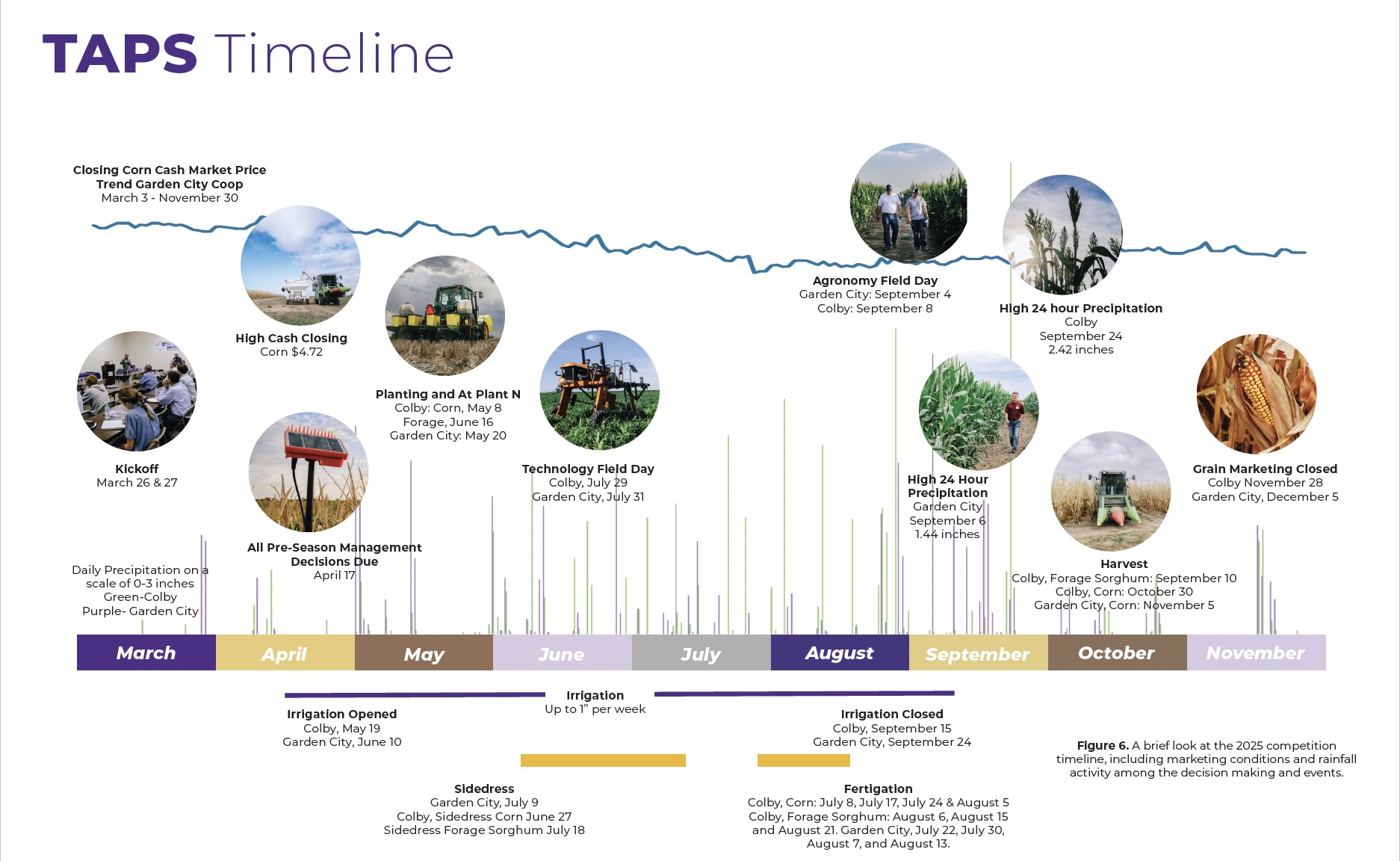
A TAPS competition follows the structure of a growing season.
Pre-season decisions establish the overall strategy, including crop selection, hybrid selection, and risk management. At planting, those decisions are implemented in the field. During the season, teams make irrigation and nitrogen decisions based on crop conditions, weather, and available data. At harvest, yield and quality are measured, and final results are calculated based on profitability and input-use efficiency.
Throughout the season, data are collected and shared, allowing participants to compare approaches and outcomes as they develop.
TAPS in Kansas
In western Kansas, water availability, input costs, and market conditions require careful management. Applying more water or more nitrogen does not guarantee better results. In many cases, timing, allocation, and overall strategy have a greater impact on profitability than total input use.
TAPS provides a structured way to evaluate those tradeoffs. By holding environmental conditions constant and varying management decisions, the program helps identify which strategies perform under the constraints common to this region.
Performance Measures
Teams are evaluated using metrics that reflect real farm priorities:
-
- Profitability
- Input-use efficiency
- Yield
- Forage quality (where applicable)
These measures provide a balanced view of performance, recognizing that high yields alone do not ensure economic return.
TAPS Results and Reports
Each season’s results are compiled into reports that document decisions, conditions, and outcomes across teams.
These reports provide a clear view of how irrigation, nitrogen, and management strategies performed under the same field conditions, with a focus on profitability and input-use efficiency.
Building Irrigation Networks for Kansas
At the core of TAPS is the goal to build a robust irrigation network that serves as a collaborative hub for growers, industry, specialists, agronomists, government entities, and more. Our research team works with key partners to cultivate a shared space for the exchange of agronomic knowledge and innovation in sustainable irrigation practices.
By organizing interactive, real-life farm management competitions, the TAPS Network drives improvements in profitability and input-use efficiency and fosters a thriving community. Together with our partners, including the Department of Agronomy, the Western Kansas Research-Extension Centers, the Kansas Center for Agricultural Resources and the Environment, natural resources districts, non-profit organizations, industry leaders, and financial institutions, we are dedicated to building a resilient and interconnected network that lays the foundation for a sustainable future in irrigation.